
2019 Spring Newsletter
FORTHCOMING EVENTS
INDOOR MEETINGS
Wednesday 27 February 2019
Club members Gary Harper and Julie Evans will give an illustrated talk on their trips to Northern Finland and Arctic Norway – Birding Northern Finland and Norwegian Arctic Coast.
Wednesday 20 March 2019
For our last indoor meeting of the winter, Club member Rob Hunt will give an illustrated talk on Birds of West Papua, New Guinea.
Meetings to commence at 7.30pm at Llanelli Cricket Club House, Denham Avenue, Llanelli. Tea/coffee/biscuits will be available at £1.20 per head.
OUTDOOR MEETINGS
Saturday, 27 April 2019
The Clubs annual walk around the Country Park of Dinefwr will start at 9.30 in the car park. Bring your membership cards if you are members of either the National Trust or West Wales Wildlife Trust. If not there will be an entrance fee. After lunch for those who wish, we will visit the River Sawdde at Llangadog for species such as Dipper and Grey Wagtail. Don’t forget to bring a packed lunch for this all day trip.
Saturday, 25 May 2019
Where else at this time of the year but to visit the magical Gwenffrwd-Dinas RSPB Reserve. Please meet at the car park at 9.30. Don’t forget to bring a packed lunch for this all day trip.
For outdoor events, check the sightings page on our website or phone Wendell on 07912577626 should there be any doubt about the weather.
REPORTS OF INDOOR EVENTS
Wednesday, 3 October 2018 – Keith Offord
For our first talk of the winter, a big thank you to Keith Offord for travelling from Oswestry to show us his amazing photography on Hen Harriers and Merlin of the Berwyn Mountains. It was a fascinating topic, I for one would love to see a male Hen Harrier sky dancing with his extravagant display of swoops, twists, somersaults and turns – may be one day.
Wednesday, 21 November 2018 – AGM followed by Becky Hulme on Red Squirrels
Thank you to Becky Hulme of the Wildlife Trust for a thoroughly interesting talk on Red Squirrels in Wales. Once a common sight, there are thought to be only three Red Squirrel populations left in Wales. On Anglesey (did you know Red Squirrels can swim?), in the Clocaenog Forest in North Wales and in the Mid-Wales Forests. Red Squirrels have declined mainly due to loss of fragmentation of woodland habitat and competition from Grey Squirrels as Greys dominate food supplies. Greys also carry the squirrelpox virus, which is deadly to Reds. Greys outnumber Reds by more than 320-1. The help of landowners, foresters and local communities is crucial to the survival of Red Squirrels in Mid-Wales. The Mid Wales Red Squirrel Partnership (MWRSP) are aiming to establish a network of landholdings all working together to achieve Red Squirrel conservation through established best practice, Grey Squirrel control and integrated habitat improvements. You can help by reporting sightings of Red Squirrels through the MWRSP website www.midwalesredsquirrels.org or b.hulme@welshwildlife.org or how do you fancy volunteering?
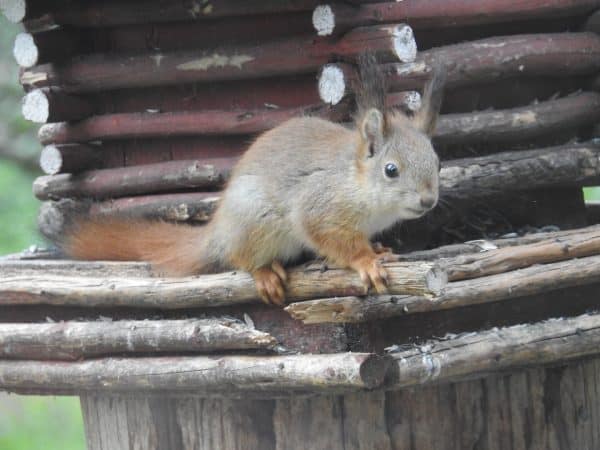
This is my picture of a Red Squirrel taken in Finland last year (Julie Evans)
| Wednesday, 12 December 2018 – Dan Jenkins-Jones Nest recording is one of the most challenging, exciting and fulfilling experiences in birding. There is the thrill of finding a nest and the satisfaction of gathering vital information. The essential tools of a nest recorder’s tools are a tapping stick (usually hazel), which is used to gently “tap” suitable habitat, which will flush out any birds sitting on nests. The other tool is a mirror stick, which is a long stick with a mirror taped to the end to enable the user to examine nests in brambles for example. Dan explained how easy it can be in finding a Willow Warbler’s nest by knowing how the female’s off-nest call will help. Thank you Dan for a very interesting and informative talk. I think it certainly gave members new ideas when looking for birds in the spring. Wednesday, 16 January 2019 – Richard Rees A huge thank you to Richard Rees who showed Club members his stunning film “Towy – The Dark River of Wales”. “Towy” is the ancient meaning of dark. The film is the story of the longest river, which runs entirely within the border of Wales. It follows the journey from sea (Llansteffan and Ferryside) to its source in the peat bogs of the Cambrian Mountains as it flows through changing landscape and seasons. The film showed us the importance of our beautiful river to the wildlife and people that live and work along its banks. I was very fascinated by the River Lampreys Richard was lucky to film preparing the river bank by moving stones in order to create the right sized depression for egg laying. REMINDERS I would be very grateful for any interesting articles or photographs from members they would like to be added to the newsletter please let us know. Please don’t forget to let me know if you change your email address – Julie |